
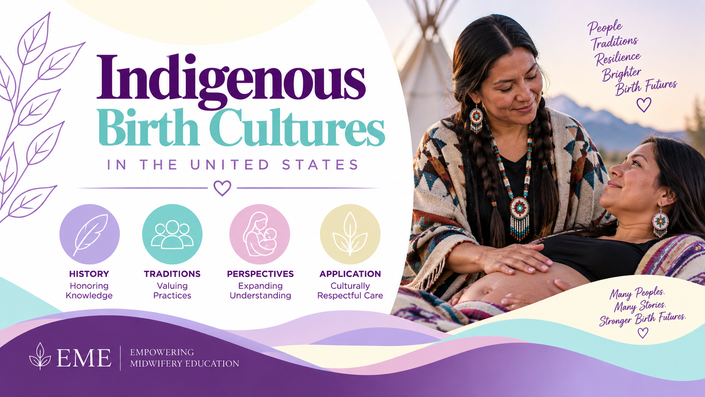
Indigenous Birth Cultures in the United States
Excellent resource for anyone caring for our indigenous communities
Honor Traditional Birth Knowledge, Explore Indigenous Maternal Health Practices, and Strengthen Culturally Respectful Maternity Care
Birth is more than a clinical event. Across Indigenous communities in the United States, pregnancy, childbirth, and postpartum care are deeply connected to cultural identity, family relationships, ancestral knowledge, spirituality, and community traditions.
The Indigenous Birth Cultures in the United States course from Empowering Midwifery Education provides an educational exploration of Indigenous childbirth traditions, historical influences, traditional birth attendants, and contemporary maternal health experiences among American Indian, Alaska Native, and Native Hawaiian communities.
Designed for midwives, nurses, doulas, birth assistants, and other maternity care professionals, this course examines how Indigenous birth knowledge, cultural practices, community relationships, and historical experiences influence pregnancy, birth, and postpartum care.
Participants will explore the importance of cultural humility, respectful communication, Indigenous reproductive sovereignty, and supporting families in incorporating personally meaningful traditions into their maternity care experiences.
What You'll Learn
- Understanding Indigenous Birth Cultures: Explore the diversity of Indigenous communities throughout the United States and the importance of recognizing distinct tribal nations, traditions, beliefs, and practices.
- Historical Perspectives on Indigenous Childbirth: Examine traditional birth attendants, community-based maternity care, and the historical transmission of birth knowledge across generations.
- Traditional Pregnancy & Birth Practices: Learn about examples of culturally significant pregnancy, labor, birth, and postpartum traditions, recognizing that practices vary widely among communities and families.
- Traditional Midwives & Birth Attendants: Explore the roles of Indigenous birth workers, traditional healers, family members, and community elders in supporting maternity care.
- Cultural Beliefs & Spiritual Considerations: Understand how ceremonies, cultural values, spirituality, and connections to ancestral lands may shape childbirth experiences.
- Family & Community Involvement: Examine the significance of kinship networks, intergenerational relationships, and community support during pregnancy, birth, and postpartum recovery.
- Postpartum Traditions & Newborn Care: Explore examples of traditional postpartum support, family-centered recovery practices, infant care, and cultural approaches to welcoming newborns.
- Colonization & Historical Trauma: Understand how forced assimilation, displacement, discriminatory healthcare practices, and restrictions on traditional healing have affected Indigenous maternity care.
- Indigenous Maternal Health Disparities: Review challenges involving healthcare access, maternal morbidity and mortality, geographic barriers, discrimination, and inequities in maternity care.
- Reproductive Sovereignty & Birth Equity: Explore the importance of informed decision-making, bodily autonomy, community leadership, and Indigenous control over reproductive healthcare.
- Contemporary Indigenous Birth Work: Learn about Indigenous-led maternal health initiatives, community birth workers, cultural revitalization efforts, and approaches to integrating traditional knowledge with modern healthcare.
- Cultural Humility in Maternity Care: Develop strategies for avoiding stereotypes, respecting individual preferences, and providing culturally responsive care.
- Supporting Traditional Practices in Clinical Settings: Explore respectful approaches to accommodating cultural preferences within appropriate clinical and safety considerations.
- Communication & Trust Building: Strengthen patient-centered communication, shared decision-making, and respectful relationships with Indigenous patients and families.
- Advocacy & Professional Responsibility: Identify opportunities to support Indigenous-led maternal health programs, equitable access to care, and culturally respectful maternity services.
Who Is This Course For?
This course is ideal for:
- Certified nurse-midwives (CNMs)
- Certified professional midwives (CPMs)
- Midwifery and nursing students
- Labor and delivery nurses
- Doulas and birth assistants
- Birth center and home birth professionals
- Women's health and maternal healthcare providers
- Childbirth educators and community health workers
- Healthcare professionals interested in cultural humility and birth equity
Whether you serve Indigenous families directly or wish to broaden your understanding of cultural diversity in maternity care, this course provides meaningful education to support respectful, inclusive, and informed clinical practice.
Why Choose This Course?
Indigenous birth traditions represent diverse and evolving systems of knowledge, family support, and cultural identity. Understanding the historical and contemporary experiences of Indigenous communities helps maternity care professionals recognize the importance of culturally respectful care and the lasting influence of healthcare inequities.
This course emphasizes that Indigenous communities are not a single cultural group and that no individual patient should be assumed to follow particular traditions based on their identity.
Through historical education, contemporary perspectives, and practical applications, participants can develop greater cultural awareness while learning to respect the knowledge, autonomy, and preferences of the families they serve.
You'll Gain the Knowledge to:
- Appreciate the diversity of Indigenous birth cultures and traditions.
- Understand the historical role of Indigenous midwives and birth attendants.
- Recognize the influence of colonization on maternal healthcare.
- Explore contemporary Indigenous maternal health experiences.
- Understand the importance of Indigenous reproductive sovereignty.
- Strengthen culturally humble communication and patient-centered care.
- Support patients' individual cultural preferences without making assumptions.
- Identify Indigenous-led resources and opportunities for continued learning.
- Promote respectful maternity care and greater birth equity.
Honor Birth Traditions, Respect Cultural Identity, and Strengthen Maternity Care
Every family deserves maternity care that respects their identity, values, cultural traditions, and personal preferences.
By learning from appropriately shared Indigenous birth knowledge and understanding the historical and contemporary experiences of Indigenous communities, maternity care professionals can develop greater cultural humility and support more respectful, equitable care.
Enroll in Indigenous Birth Cultures in the United States today and expand your understanding of Indigenous maternity care traditions, cultural perspectives, and approaches to respectful, patient-centered birth care!
Educational Disclaimer: Indigenous nations and communities have distinct cultural traditions, knowledge systems, and healthcare practices. This course provides general cultural and historical education and does not represent the beliefs or practices of every Indigenous community. Sacred, restricted, or community-specific knowledge should not be reproduced or taught without appropriate permission. Course materials should prioritize Indigenous-authored resources, community-approved teachings, and Indigenous-led perspectives.
Your Instructor

Dr. Jill Chasse is an experienced and accomplished Doctor of Public Health and Indigenous Medicine (DSTIM), Perinatal Epidemiologist and Certified Clinical Trauma Specialist with over 20 years of experience as a birth worker in both health and psychology. In addition, she has over a decade of midwifery schooling and apprenticeships including homebirth, birth center, and hospital experience. She is also a Certified Functional Medicine Practitioner and holds a a state registration in naturopathic medicine
Her clinical strengths are in the areas of applied clinical epidemiology including clinical trauma, neuropsychology and psychopathology. Her preventive medicine concentration from her public health post graduate focus is in tropical medicine and global maternal/ infant health. She has worked in various federal health agencies including NIH and the CDC and is a certified EMT and Certified Lactation Counselor (CLC) through CBI.
In 2020, Dr. Chasse passed her Board Certification in Naturopathic Medicine (ND) and was honored with a Doctor of Humanitarian Services award (DHS) . She is dedicated to volunteer and humanitarian work and has worked as a Duty Officer for the Red Cross Disaster Action Response, a Volunteer State Coordinator for Postpartum Support International (PSI), and a Medical Reserve Corps field epidemiologist.
Dr. Chasse lives in Northern NJ with her husband and amazing teenagers. She works as Adjunct Professor and Instructor at several universities, schools and programs and sees clients at Flor da Vida Women's Wellness Center. She enjoys teaching both the science and art of maternal/perinatal health, global health, and integrative medicine.
-Dr. Jill Diana Chasse, DrPH, PhD, MPA, MSpsy, IMD, CLC, CCTS-P, CFMP, DSTIM, ND