
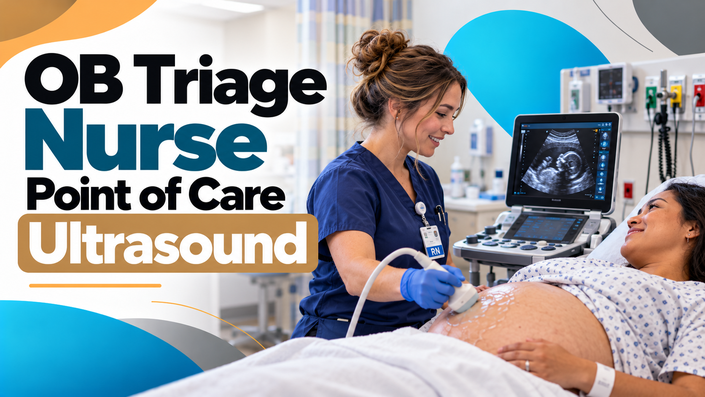
OB Triage Nurse Point of Care Ultrasound
Strengthen Your Ultrasound Knowledge, Enhance Obstetric Triage Assessments, and Support Timely Clinical Decision-Making
Obstetric triage nurses play an essential role in evaluating pregnant patients, recognizing potential complications, and coordinating timely maternity care. As point-of-care ultrasound (POCUS) becomes increasingly integrated into obstetric healthcare, understanding its applications can help nurses strengthen clinical assessments, improve interdisciplinary communication, and support safe, efficient patient care.
The OB Triage Nurse Point of Care Ultrasound course from Ultrasound Trainings provides comprehensive, evidence-based education designed specifically for obstetric triage nurses, labor and delivery nurses, and maternity care professionals seeking to expand their knowledge of focused bedside ultrasound.
This course explores ultrasound fundamentals, equipment operation, image optimization, fetal presentation and position, amniotic fluid assessment, placental location, fetal cardiac activity, and common clinical situations encountered in obstetric triage.
Whether you're new to ultrasound, strengthening your obstetric assessment knowledge, or pursuing additional clinical training, this course provides practical education to help you understand how focused ultrasound can support patient evaluation and timely escalation of care within authorized nursing responsibilities.
What You'll Learn
- Introduction to OB Triage POCUS: Understand the purpose, clinical benefits, limitations, and appropriate applications of point-of-care ultrasound in obstetric triage.
- Ultrasound Physics & Safety: Review ultrasound principles, image formation, common artifacts, and safe ultrasound practices, including the ALARA principle.
- Ultrasound Equipment & Knobology: Learn transducer selection, probe orientation, depth, gain, focus, and essential ultrasound machine controls.
- Image Acquisition & Optimization: Explore ultrasound scanning planes, anatomical landmarks, image quality, and techniques for obtaining clear focused images.
- Obstetric Ultrasound Anatomy: Recognize common fetal and maternal anatomical structures relevant to bedside obstetric assessments.
- Fetal Lie & Presentation Assessment: Understand sonographic identification of cephalic, breech, transverse, and oblique presentations.
- Fetal Position Assessment: Explore fetal anatomical landmarks used to determine position and orientation during pregnancy and labor.
- Amniotic Fluid Evaluation: Review deepest vertical pocket and amniotic fluid index measurement techniques, expected findings, and recognition of concerning fluid volumes.
- Placental Location Assessment: Understand focused ultrasound visualization of placental location and findings that require additional diagnostic evaluation.
- Fetal Cardiac Activity: Review appropriate ultrasound methods for identifying fetal cardiac activity and the limitations of focused assessments.
- Early Pregnancy Triage Considerations: Explore sonographic findings relevant to early pregnancy assessment, including pregnancy location, gestational structures, and findings requiring urgent evaluation.
- Evaluation of Vaginal Bleeding: Understand the potential role and limitations of ultrasound in patients presenting with bleeding, including the importance of excluding serious obstetric complications.
- Suspected Rupture of Membranes: Explore how amniotic fluid assessment may contribute to clinical evaluation while recognizing that ultrasound alone cannot confirm or exclude membrane rupture.
- Decreased Fetal Movement: Review the role of focused ultrasound within a broader evaluation that may include fetal heart rate monitoring and additional diagnostic assessment.
- Preterm Labor & Obstetric Complaints: Explore selected ultrasound applications relevant to triage evaluations and indications for further clinical assessment.
- Intrapartum Ultrasound Applications: Understand how focused ultrasound may support assessment of fetal presentation and position during labor.
- Recognizing Concerning Ultrasound Findings: Identify findings that require additional evaluation, comprehensive diagnostic imaging, consultation, or urgent intervention.
- Clinical Prioritization & Escalation of Care: Understand how ultrasound findings may contribute to triage decisions when interpreted alongside maternal symptoms, vital signs, fetal monitoring, and clinical history.
- Documentation & Clinical Reporting: Review ultrasound-related documentation, image labeling, storage, reporting, and communication with the maternity care team.
- Nursing Scope of Practice & Clinical Competency: Understand institutional policies, state nursing regulations, supervised training, professional responsibilities, and competency requirements.
- Interdisciplinary Communication: Strengthen collaboration among obstetric nurses, midwives, physicians, sonographers, and emergency care professionals.
- Integrating POCUS Into OB Triage Workflows: Explore practical considerations for equipment readiness, patient flow, clinical protocols, and quality assurance.
Who Is This Course For?
This course is ideal for:
- Obstetric triage registered nurses
- Labor and delivery nurses
- Obstetric emergency department nurses
- Antepartum and high-risk pregnancy nurses
- Maternal-fetal medicine nursing professionals
- Obstetric clinical nurse specialists
- Maternity care nurse educators
- Advanced practice nurses involved in obstetric triage
- Experienced maternity care nurses seeking additional ultrasound education
- Healthcare professionals interested in focused ultrasound applications in obstetric emergency and triage settings
Whether you work in a hospital labor and delivery unit, obstetric emergency department, or maternity care assessment setting, this course provides practical education tailored to your clinical environment.
Why Choose This Course?
Obstetric triage requires rapid recognition of clinical concerns, effective prioritization, accurate communication, and timely coordination of care.
Patients may present with abdominal pain, vaginal bleeding, contractions, suspected rupture of membranes, decreased fetal movement, or other symptoms that require careful maternal and fetal evaluation.
Point-of-care ultrasound may provide additional focused clinical information when used by appropriately trained and authorized healthcare professionals. However, ultrasound findings must be considered alongside the patient's history, physical examination, vital signs, fetal monitoring, and other necessary assessments.
This course provides education specifically tailored to obstetric triage nursing, connecting ultrasound fundamentals with common clinical scenarios and emphasizing appropriate examination limitations, patient safety, and interdisciplinary teamwork.
You'll Gain the Knowledge to:
- Understand the role of POCUS in obstetric triage.
- Strengthen familiarity with ultrasound equipment and image optimization.
- Recognize basic maternal and fetal sonographic anatomy.
- Understand fetal presentation and position assessment techniques.
- Review amniotic fluid and placental evaluation principles.
- Recognize clinical scenarios in which focused ultrasound may be useful.
- Identify concerning findings that require additional evaluation.
- Understand the limitations of ultrasound in obstetric emergencies.
- Improve communication and documentation of ultrasound-related findings.
- Recognize nursing scope-of-practice and institutional competency requirements.
- Support timely, organized, and patient-centered obstetric triage care.
Advance Your OB Triage Knowledge and Strengthen Your Clinical Confidence
Obstetric triage nurses are essential members of the maternity care team, often providing the first clinical assessment for patients presenting with pregnancy-related concerns.
Developing a strong understanding of point-of-care ultrasound can enhance clinical awareness, strengthen interdisciplinary communication, and support coordinated maternal and fetal care.
With structured education, appropriate hands-on training, and continued professional development, nurses can expand their ultrasound knowledge while maintaining safe clinical practices and clearly defined professional responsibilities.
Enroll in OB Triage Nurse Point of Care Ultrasound today and take the next step toward strengthening your ultrasound knowledge, advancing your obstetric triage assessment skills, and supporting high-quality maternal and fetal care!
Educational Disclaimer: This course provides professional ultrasound education and does not independently establish clinical competency, confer certification, or authorize nurses to independently perform or interpret diagnostic ultrasound examinations. Nursing scope-of-practice requirements vary by state, healthcare facility, professional qualifications, and institutional policies. Hands-on training, supervised scanning, documented competency, and additional authorization may be required. POCUS does not replace comprehensive diagnostic ultrasound, continuous or indicated fetal monitoring, emergency evaluation, or specialist consultation. Ultrasound assessments should never delay necessary emergency care.
Course Curriculum
-
PreviewIntroduction to Medical Ultrasound Implementation (8:49)
-
PreviewScope of Practice, Professional Standards, and Practice Guidelines (12:32)
-
PreviewEthical Considerations with Ultrasound Implementation (9:57)
-
StartUltrasound Terminology (14:55)
-
StartUltrasound Ergonomics (7:38)
-
StartTransabdominal Ultrasound (8:44)
-
StartImportance of Application Use Within Obstetrical Nursing (9:22)